

Exploring the Ancient Dharmarajika Stupa- History Unfolds
Imagine a place where the very air seems to hold the echoes of ancient chants, a place where stones, weathered by centuries, tell a story of unwavering faith. This isn't just a fantasy; it's the living legacy of the Dharmarajika Stupa in Taxila, Pakistan. This isn't merely a historical monument; it's a spiritual anchor, a testament to a time when an emperor’s devotion reshaped a subcontinent. Standing before it, you can almost feel the presence of Emperor Ashoka, the great Mauryan king who, in the 3rd century BCE, chose this very spot to enshrine sacred relics of the Buddha.
For those of us whose hearts beat in rhythm with India's rich past, the Dharmarajika Stupa is a powerful reminder of our shared spiritual heritage. It’s a journey back in time, to the very roots of Buddhist devotion and artistic expression.
The Royal Roots: Ashoka's Vision of Dharma
The story of this stupa is inseparable from its creator, Emperor Ashoka. Often referred to as 'Dharma Raja' or the Righteous King, Ashoka’s journey from a conquering warrior to a passionate advocate for peace and Buddhism is legendary. The Dharmarajika Stupa was a cornerstone of his mission to spread the Buddha's teachings. He envisioned a network of such monuments across his empire, each housing a fragment of the Buddha's relics, making the sacred accessible to all.
Taxila, where the stupa stands, was no ordinary city. It was a bustling crossroads of knowledge and culture on the ancient Silk Road, a place where ideas from Greece, Persia, and India mingled freely. By building this grand stupa here, Ashoka created a focal point for spiritual energy, a place where travellers, scholars, and devotees could gather. This ancient monument served as a bridge, connecting not just trade routes, but also diverse spiritual traditions of the time.
An Architectural Marvel Whispering Spiritual Truths
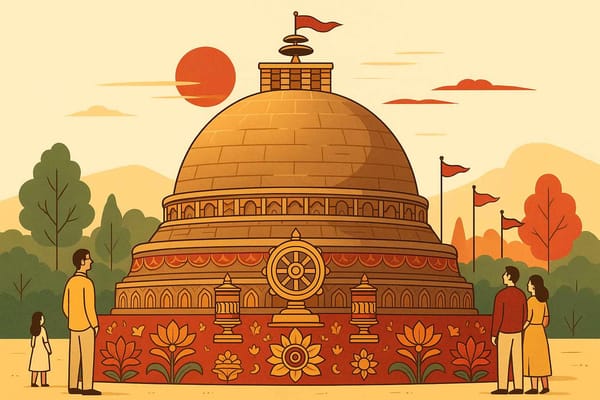
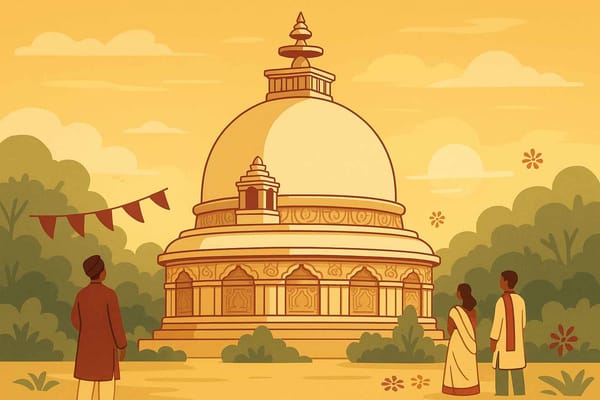
The design of the Dharmarajika Stupa is a beautiful lesson in Buddhist philosophy, crafted in stone. Its architecture is not just for show; every element has a profound meaning that guides the devotee towards enlightenment.
- The Anda (Hemispherical Dome): The massive dome, which forms the main body of the stupa, represents the boundless universe and the infinite nature of the Buddha's teachings. Its simple, perfect shape evokes a sense of calm and completeness, inviting the mind to settle into meditation.
- The Pradakshina Path (Circumambulatory Path): Surrounding the dome is a wide path for walking meditation. Devotees would circle the stupa in a clockwise direction, a practice known as *pradakshina*. This rhythmic movement is a form of active worship, helping to focus the mind and absorb the spiritual vibrations of the sacred relics held within.
- Gandharan Artistry: The stupa and its surrounding monastery showcase exquisite examples of Gandharan art, a unique fusion of Indo-Greek and Buddhist styles. The intricate carvings and sculptures tell stories from the Buddha's life, transforming the structure into a visual scripture for pilgrims. Just as the splendor of Jagdish Temple’s architecture narrates tales of Vaishnava traditions, the art here brings Buddhist legends to life.
A Sanctuary for the Soul: The Heart of Devotion
At its core, the Dharmarajika Stupa was built to be a *dhatu-garbha* stupa, a relic depository monument. It was constructed to protect and honour what are believed to be the mortal remains of the Buddha himself. For centuries, this made it one of the most sacred pilgrimage sites in the Buddhist world. Pilgrims would travel for months, crossing mountains and deserts, just for a moment of connection at this holy place.
The inscriptions and artifacts discovered here tell countless stories of devotion. They speak of ordinary people and noble patrons who contributed to the stupa’s upkeep, hoping to earn merit and spiritual blessings. This wasn't just a monument to a distant figure; it was a living centre of faith, a place where the community came together to meditate, learn, and feel united in their spiritual quest.
Understanding such deep-rooted traditions is at the heart of what we do at Bhaktilipi. We believe that these stories of faith are timeless. If you wish to bring a piece of this sacred tradition into your home, you can explore our collection of authentic puja items, like the beautifully crafted Puja Thali Sets, designed to honour your own spiritual practices with the same reverence.
Unearthing History: Excavations and Discoveries
The stupa has witnessed the rise and fall of empires. It was damaged over the centuries, notably by the Huns in the 5th century CE, and later tragically demolished for building materials in 1794. However, its spiritual significance never faded. It was in the early 20th century, between 1912 and 1916, that British archaeologist Sir John Marshall led systematic excavations, bringing this forgotten treasure back to the world's attention.
His team unearthed incredible finds that help us piece together the past. Among them were precious relic caskets, including one of green marble, coins from various dynasties, pottery, and stunning statues of Bodhisattvas. These discoveries are not just historical artifacts; they are keys to understanding the daily life, trade, and unwavering faith of the people who lived and worshipped here. This entire monastic complex is so significant that it is now recognized as part of the Ruins of Taxila, a UNESCO World Heritage Site.
The Dharmarajika Stupa in Our Times
Today, visitors can walk the same paths as ancient pilgrims. While preservation efforts are in place to protect this fragile site, it remains open for those who wish to experience its serene and powerful atmosphere. It stands as a symbol of our shared South Asian heritage and fosters a spirit of interfaith understanding.
For modern-day seekers and history enthusiasts, a journey to the Dharmarajika Stupa is more than just a trip; it's a connection to the roots of a profound spiritual tradition. It reminds us that like the historical sites of Udaipur, these places are not just relics of the past but are filled with enduring wisdom for the present.
Preserving and sharing this wisdom is the purpose of Bhaktilipi. Our platform is a digital space dedicated to timeless devotional literature and stories that connect our traditions with modern life. From insightful articles to our curated collection of spiritual books, we aim to enrich your journey of discovery.
A Legacy That Endures
The Dharmarajika Stupa is a timeless beacon of spiritual devotion. It teaches us that faith, when expressed with pure intention, can create something that outlasts empires and inspires humanity for millennia. Its silent dome and ancient stones hold a powerful message of peace, righteousness, and the eternal quest for enlightenment—a message that is just as relevant today as it was in the time of Emperor Ashoka.
A passionate group of people dedicated to preserving India's knowledge of Dharma, Karma, and Bhakti for ourselves and the world 🙏.
Comments
Related in

Dharmarajika Stupa- History Reveals Significance
Some places in the world don't just exist in the present; they carry the whispers of centuries within their very stones. Imagine standing on ground that witnessed a great emperor's change of heart, a place where the message of peace was shaped into a magnificent structure.
Dharmarajika Stupa: Journey Through History
Have you ever stood in a place so ancient that you can almost hear the whispers of history in the wind? A place where the stones themselves seem to tell stories of emperors, monks, and seekers from centuries ago. One such place is the magnificent Dharmarajika Stupa, nestled near Taxila
Dharmarajika Stupa- History's Journey Explores Mysteries
Have you ever felt the pull of a place you’ve never visited? A place where history isn't just in books, but whispers from the very stones themselves. For me, the Dharmarajika Stupa in Taxila, now in Pakistan, is one such place. It’s a silent witness to