
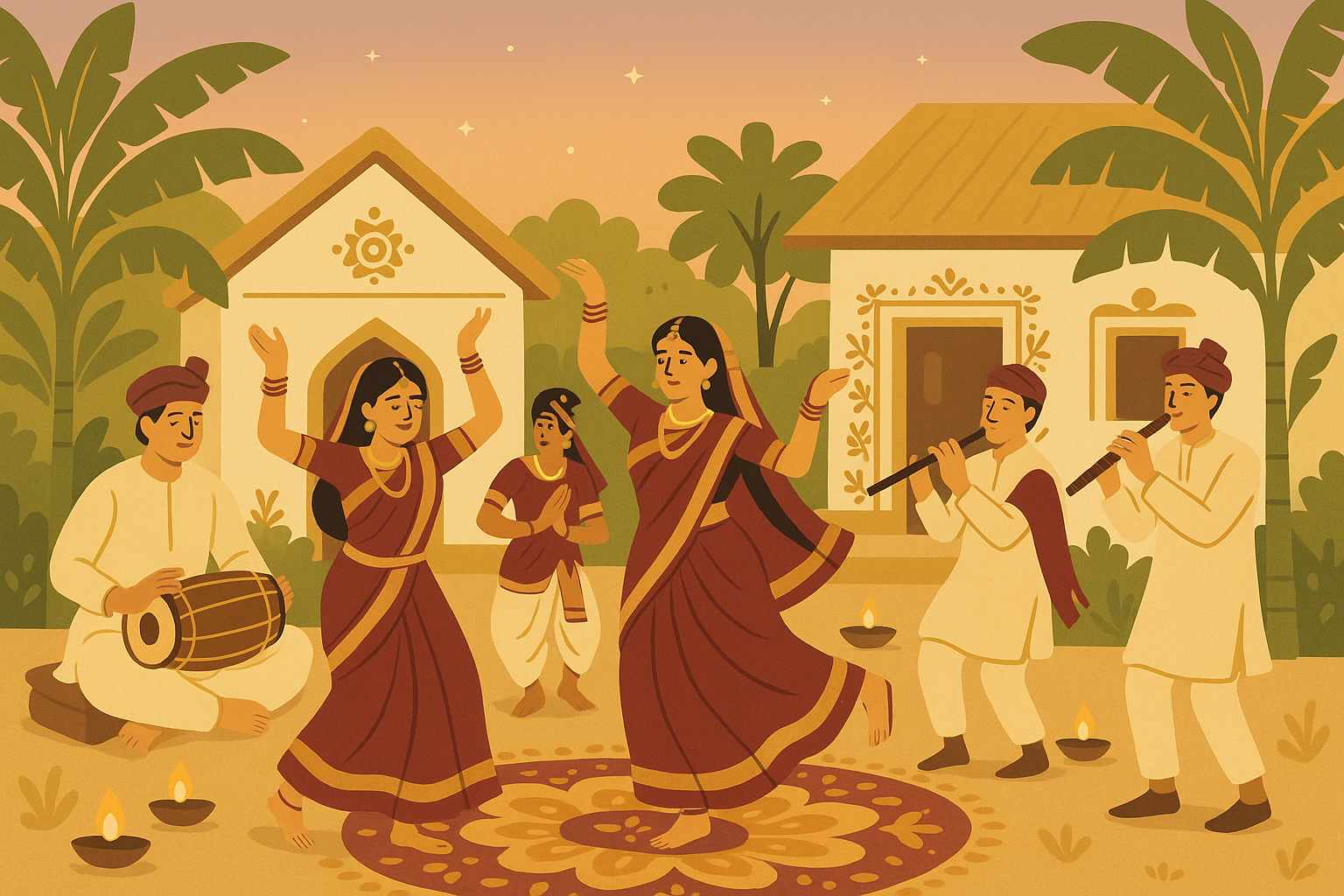
Bhojpuri culture grows from a language and a network of communities rather than from one state or a neatly bounded territory. Bhojpuri is widely associated with eastern Uttar Pradesh and western Bihar, with speakers elsewhere in India, the Nepal Terai and global diaspora communities. Local identities, caste, religion, gender, occupation and migration all shape how that culture is lived.
No single menu, festival, song or rural image can represent every Bhojpuri speaker. A useful introduction should recognise variation, distinguish evidence from nostalgia and avoid treating contemporary communities as unchanged remnants of an “ancient heartland.”
A linguistic region, not a state
The “Bhojpuri region” is a convenient cultural and linguistic description, not an official administrative unit. Its boundaries shift according to speech, migration and the question being studied. Bhojpuri-speaking districts sit within larger political states whose populations use many languages.
The Government of India’s Linguistic Survey material for Uttar Pradesh describes a complex field of language and mother-tongue identities rather than a map of sealed linguistic blocks. Bihar likewise includes Bhojpuri alongside languages such as Maithili, Magahi, Hindi and Urdu. Jharkhand and neighbouring areas add further multilingual settings.
It is therefore safer to say “Bhojpuri-speaking areas” than to imply one culturally uniform province.
Bhojpuri as a language
The Census of India’s C-16 mother-tongue table records Bhojpuri returns within the national language data. Census categories are administrative tools: they show how responses were classified, but they do not settle every linguistic debate about whether a speech form is a language, dialect or part of a wider language continuum.
Bhojpuri is commonly written in Devanagari today. Kaithi also has an important historical association with writing in north India. Spoken Bhojpuri varies by location and community, and speakers frequently move between Bhojpuri, Hindi, Urdu, English and other languages depending on context.
Calling Bhojpuri merely “broken Hindi” dismisses its grammar, vocabulary, literature and expressive traditions. Calling it entirely uniform is equally misleading.
Bhojpuri and official recognition
As of this update, the Union government’s official Eighth Schedule list contains 22 languages and does not list Bhojpuri separately. A 2025 Ministry of Home Affairs parliamentary answer confirms continuing demands for inclusion but says there are no fixed criteria for considering a language.
This constitutional status should not be confused with whether Bhojpuri is a real language or has cultural value. Census use, state policies, education, broadcasting, literature and constitutional scheduling are different forms of recognition.
The old duplicate’s claim that a named political leader supported imminent recognition has been removed. Advocacy continues, but no article should imply that inclusion has happened or has a guaranteed timetable.
History without a single origin myth
The Bhojpuri-speaking zone includes places with long and different histories: ancient polities, Buddhist and Jain sites, medieval kingdoms, Mughal and regional administrations, colonial districts and modern states. It cannot accurately be reduced to “the heart of the Magadha Empire,” nor can references in epics establish a continuous Bhojpuri identity for every ancient period.
Modern Bhojpuri identity developed through changing speech communities, local courts, agriculture, markets, religious networks, print, performance and migration. Figures such as Kunwar Singh belong to important regional and anti-colonial histories, but one hero cannot stand for every district or community.
Migration within India
Seasonal and long-term migration has shaped Bhojpuri social life for generations. Work, military service, trade, education and marriage connected villages and towns to Kolkata, Mumbai, Delhi, Punjab, Assam and other regions. Separation, return and uncertain livelihood recur in folk expression because they were and remain lived experiences.
Bidesia, associated especially with playwright and performer Bhikhari Thakur, turned migration, gender relations and social tension into popular theatre. The term should not be used as a decorative synonym for every Bhojpuri song; it names a specific and evolving performance legacy.
Indenture and global Bhojpuri worlds
During the nineteenth and early twentieth centuries, colonial indenture carried people from north India and other regions to plantation colonies including Mauritius, Fiji, Guyana, Suriname and Trinidad. UNESCO’s indentured-labour records document the system and its human consequences.
Bhojpuri travelled through those migrations, but overseas communities did not simply preserve an unchanged Indian original. Their languages and practices developed through contact with other Indian languages, colonial languages, Creoles and new national settings.
Mauritius provides a clear example. UNESCO inscribed Bhojpuri folk songs in Mauritius, Geet-Gawai, in 2016. It describes a pre-wedding practice combining ritual, prayer, song, music and dance. Geet-Gawai is Mauritian intangible heritage, not evidence that all Bhojpuri weddings everywhere follow one script.
Folk song and performance
Bhojpuri-speaking communities sustain many song and performance forms. Names commonly encountered include birha, kajri, chaita or chaiti, sohar, vivah geet and phagua. Their meanings, occasions and musical forms vary by district, performer and historical period.
- Birha is associated with separation and developed into important performance traditions.
- Kajri is linked with the rainy season across a wider north Indian region, not exclusively with Bhojpuri speakers.
- Chaita is associated with the month of Chait and seasonal performance.
- Sohar and wedding-song repertoires accompany life-cycle occasions, often sustaining women’s expressive traditions.
- Phagua songs are associated with Holi and spring, with styles differing between communities.
Recordings, stage shows, radio, cinema and digital platforms have transformed these traditions. “Folk” does not mean static, anonymous or untouched by commerce.
Bhojpuri cinema and popular media
Bhojpuri-language cinema, music video and television connect large audiences, but they are not transparent mirrors of everyday culture. Popular media can preserve language visibility while also amplifying stereotypes, commercial formulas and unequal representations of gender or caste.
The nickname “Bhojiwood” is a media label, not the formal name of one unified institution. View films as creative works produced in particular periods, not as ethnographic proof about all Bhojpuri people.
Festivals and religious diversity
Chhath is strongly associated with Bihar, eastern Uttar Pradesh and Bhojpuri-speaking communities. Its disciplined offerings to the sun at water bodies have also travelled through migration. Yet Chhath is shared beyond Bhojpuri identity and practices differ among families and locations.
Holi, Diwali, Eid, Muharram, Durga Puja, Ram Navami, local deity traditions and many other observances form part of the region’s religious life. Not every Bhojpuri speaker is Hindu, and no single festival defines the language community.
Travel writing should not describe women as uniformly standing waist-deep in water or performing every vow. Roles, safety conditions, gender participation and ritual choices vary.
Food: shared regional repertoires
Litti with chokha is widely associated with Bihar and neighbouring regions and is popular in Bhojpuri-speaking areas. Sattu, grains, pulses, seasonal vegetables, pickles and breads appear in many local diets. The exact dishes and ingredients vary with household, season, religion, caste, income and migration.
Dishes such as thekua, malpua, dal pitha, khichdi and preparations using gram flour or roasted grains may be important in particular homes or festivals, but none belongs exclusively to Bhojpuri culture. Avoid claims that the cuisine is inherently simple, rustic or designed only for agricultural labour; those descriptions turn living food traditions into class stereotypes.
Cow-dung cakes are one traditional fuel in some contexts, not a defining or required cooking method. Modern kitchens, restaurants and diaspora homes adapt recipes in many ways.
Craft and material culture
The old articles claim distinctive Bhojpuri pottery and textiles without identifying named traditions, producer communities or reliable documentation. Eastern Uttar Pradesh and western Bihar certainly have diverse weaving, pottery, basketry, embroidery and ritual arts, but these must be attributed to specific places and makers.
Do not market a generic “Bhojpuri craft” by borrowing better-documented traditions from elsewhere in Bihar or Uttar Pradesh. Ask who made an object, where, for what use and under what name.
How to engage respectfully
- Treat Bhojpuri as a living language with internal variation, not comic or “rough” Hindi.
- Do not assume a speaker’s religion, caste, occupation, education or politics from their language.
- Credit singers, writers, performers and craftspeople when their work is known.
- Distinguish shared regional foods and festivals from traditions exclusive to Bhojpuri communities.
- Recognise overseas Bhojpuri cultures as locally created traditions, not cultural replicas.
- Use current constitutional and census sources when discussing official status or speaker data.
Frequently asked questions
Where is the Bhojpuri region?
It broadly refers to Bhojpuri-speaking areas of eastern Uttar Pradesh and western Bihar, with neighbouring and migrant communities elsewhere. It has no single official border.
Is Bhojpuri a language or a dialect?
Bhojpuri has its own grammar, vocabulary, literature and large speech community. Labels vary across linguistic scholarship and government classification; calling it simply defective Hindi is inaccurate.
Is Bhojpuri in the Eighth Schedule?
No. The current official list has 22 languages and does not separately include Bhojpuri, although demands for its inclusion continue.
Is Bhojpuri spoken outside India?
Yes. Migration and indenture helped establish Bhojpuri-speaking communities overseas, whose language and culture evolved in distinct local forms.
Is litti chokha exclusively Bhojpuri?
No. It is strongly associated with Bihar and adjoining areas and is eaten in Bhojpuri-speaking communities, but it belongs to a wider, shared regional food landscape.
Sources and further reading
- Census of India: mother-tongue data, 2011
- Census of India: Linguistic Survey of Uttar Pradesh
- Department of Official Language: Eighth Schedule languages
- Ministry of Home Affairs: 2025 parliamentary answer on Bhojpuri
- UNESCO: records of Indian indentured labourers
- UNESCO: Bhojpuri folk songs in Mauritius, Geet-Gawai