
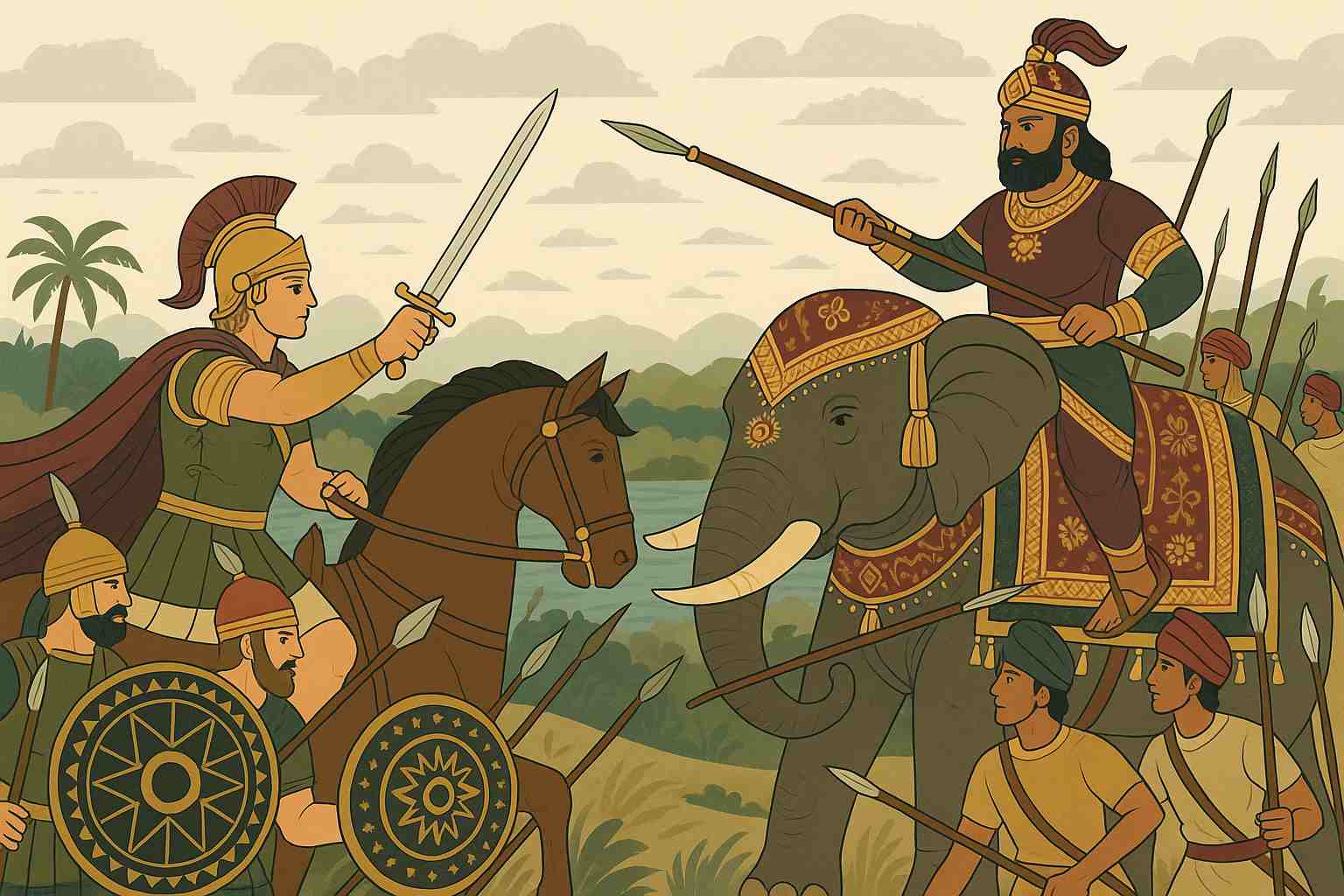
Alexander vs. Porus: Battle at the Hydaspes Defines Ancient Warfare
Some stories are not just written in books; they are etched into the very soul of the land. Imagine the banks of a mighty river, swollen and furious with monsoon rains. On one side, a world-conqueror, Alexander the Great, driven by an insatiable ambition. On the other, a proud Indian king, Porus, standing as the unyielding guardian of his motherland. This isn't just history; it's a saga of courage, strategy, and a clash of two powerful worlds that unfolded in 326 BCE on the banks of the Hydaspes River, known to us today as the Jhelum.
This battle was more than a mere collision of armies. It was a moment where the tactical genius of the West met the unshakeable spirit of the East. It was a test of wills that would leave an indelible mark on history and reveal the true character of these two legendary leaders.
Two Worlds on a Collision Course
To truly understand the weight of this moment, we must look at the paths that led these two great men to the riverbank. Their confrontation was destined, shaped by forces much larger than themselves.
- Alexander's Unstoppable March: The Macedonian king was no ordinary ruler. Having already brought the mighty Persian Empire to its knees, his eyes were set on the fabled lands of India. His journey eastward was fuelled by a desire to reach the world's end, to conquer not just lands but also the unknown itself. His army was a seasoned, well-oiled machine, loyal to their charismatic leader.
- The Pride of the Pauravas: In the 4th century BCE, the Indian subcontinent was a vibrant mosaic of kingdoms. Among them, the Paurava kingdom in Punjab, ruled by the valiant King Porus (Raja Puru), stood as a formidable power. Porus wasn't just a king; he was a symbol of Indian sovereignty, known for his towering height, immense courage, and deep love for his people.
The River as a Witness
The Hydaspes River itself played a crucial role. More than just a line on a map, it was a living, breathing challenge. The monsoons had turned it into a raging torrent, a natural fortress for Porus's kingdom. Crossing it seemed impossible, a challenge that would test the limits of even Alexander's brilliance. The river's ancient path holds many such stories, secrets of battles won and lost. If you're fascinated by how geography shapes history, you might find an interesting parallel in the story of the enigma of the Hydaspes river's ancient path.
Where Giants Clashed: The Battle on the Jhelum
As the storm clouds gathered, so did the armies. Porus prepared to defend his home with everything he had, his greatest strength being the terrifying war elephants, creatures the Macedonians had never faced on such a scale. Alexander, on the other hand, knew that a direct assault across the raging river would be suicide. His victory would have to be won through cunning and audacity.
And so, Alexander devised a masterstroke. He made a great show of preparing to cross at one point, drawing Porus's attention. Then, under the cover of a dark, stormy night, he led a portion of his army on a secret crossing miles upstream. It was a massive gamble, but it paid off. By dawn, a part of the Macedonian army was on Porus's side of the river, and the element of surprise was theirs.
The Roar of Elephants and the Discipline of the Phalanx
The battle that followed was one of the fiercest Alexander ever fought. Porus's war elephants charged, causing chaos and panic among the Macedonian ranks. These majestic beasts were like living tanks, trampling soldiers and creating gaps in the disciplined phalanx. But Alexander's genius was in adaptability. He instructed his soldiers not to face the elephants head-on but to target their mahouts (handlers) and strike at their eyes and legs. Slowly, the wounded and leaderless elephants became a liability, turning back and trampling Porus's own infantry.
Even with his army in disarray, King Porus fought with incredible bravery. Wounded and surrounded, he refused to surrender, a true king defending his realm to his last breath. His leadership inspired his men to fight with fierce determination against one of the most successful armies in history.
A Victor's Respect, A King's Dignity
Ultimately, Alexander's superior tactics and the discipline of his army won the day. Porus was captured. What happened next is what makes this story truly timeless. Alexander, deeply impressed by the courage and dignity of his opponent, approached Porus and asked him how he wished to be treated.
Porus, standing tall despite his defeat, gave a reply that has echoed through centuries: "Treat me as a king."
This response struck a chord with Alexander. He saw in Porus not a vanquished foe, but a kindred spirit—a true leader. In an incredible act of respect, Alexander not only returned Porus's kingdom to him but also expanded it, making him a trusted ally. This battle, though a military victory for Alexander, was a moral victory for Porus. It showcased that true royalty lies not in victory or defeat, but in one's character and honor.
This historic encounter also marked the easternmost point of Alexander's conquests. His army, exhausted and hearing tales of even larger Indian empires beyond, refused to march further. The battle on the Hydaspes had shown them the formidable spirit of India. The subsequent blending of cultures left a lasting impact, a fascinating chapter in history much like the later interactions explored in the rise of the Kushano-Sasanian empires.
Stories like this, of profound courage and timeless wisdom, are the bedrock of our heritage. They teach us about leadership, honor, and the enduring human spirit. At Bhaktilipi, we believe in bringing these powerful narratives to light. If you are moved by the tale of Alexander and Porus, we invite you to explore more such inspiring stories from our rich past on our platform. Find out more about our mission to preserve these traditions on our About Us page.
A Legacy That Endures
Why do we still talk about the Battle of the Hydaspes over two millennia later? Because it teaches us invaluable lessons. It demonstrates how geography and weather can shape destiny, and how innovative strategy can overcome seemingly insurmountable odds. More importantly, it is a profound story of mutual respect between adversaries, a rare and noble quality in the annals of warfare.
The encounter between Alexander and Porus reminds us that history is not just about dates and events, but about the people who shaped them. It's a testament to the fact that while empires may rise and fall, the legacy of bravery and honor is what truly stands the test of time.
Stay connected to your roots and discover more tales that inspire and educate. Subscribe to our newsletter for regular updates, and follow our journey on Facebook, Instagram, and YouTube. Let's keep these timeless stories alive together.
A passionate group of people dedicated to preserving India's knowledge of Dharma, Karma, and Bhakti for ourselves and the world 🙏.